
When you have Osteoarthritis (OA), every step or movement can be a challenge. But you don’t have to accept a life of limitations or rush into surgery. At QC Kinetix, our regenerative health providers offer nonsurgical, drug-free alternatives designed to help you return to an active lifestyle. By utilizing the body’s natural recovery mechanisms, our biologic treatments aim to reduce pain and improve joint function without invasive procedures.
Why Choose QC Kinetix for Joint Pain Relief?

Osteoarthritis is the most common form of arthritis, often referred to as “wear and tear” arthritis. It involves gradual changes within the joint where the protective cartilage that cushions the ends of your bones wears down over time. As this buffer diminishes, it can lead to pain, stiffness, and reduced movement.
While it can damage any joint, the disorder most commonly affects joints in your hands, knees, hips, and spine.
Patients often ask, “Is osteoarthritis an autoimmune disease?” The answer is generally no. Osteoarthritis is classified as a degenerative joint disease caused by the breakdown of joint tissues. This is different from rheumatoid arthritis (RA), which is an autoimmune disease where the body’s immune system mistakenly attacks the lining of the joints.
However, even though OA is not autoimmune, it still involves inflammation that causes pain and stiffness.
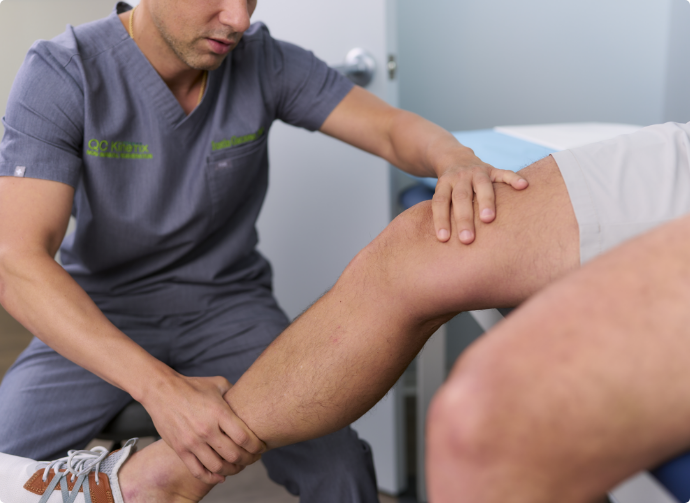
The symptoms of OA often develop slowly and worsen over time. Recognizing the signs early can help you seek osteoarthritis pain relief options before the condition severely limits your daily activities.
Common symptoms include:
Note: If you have joint pain or stiffness that doesn’t go away, or if your mobility is worsening, it is time to consult with a medical team about your options.
Understanding what causes osteoarthritis is the first step in managing it. While it is often associated with aging, several factors can increase the risk of developing this condition.
Major contributors include:



Osteoarthritis is a progressive condition. Providers often classify it into four stages to help determine the best course of action. So, what are the 4 stages of osteoarthritis?
Staging depends on a combination of symptoms and imaging; a thorough evaluation by a regenerative health provider is essential to determine the severity of your condition.
A common question we hear is, “Can osteoarthritis be reversed?” Currently, there is no known cure that can completely reverse the structural damage of osteoarthritis or “regrow” lost cartilage entirely. However, this does not mean the situation is hopeless.
While the condition cannot be strictly reversed, the progression can often be slowed, and the symptoms can be managed effectively. With the right plan, many patients see significant improvements in function and a reduction in pain without resorting to surgery. Our goal at QC Kinetix is to help you maintain your quality of life through any stage of osteoarthritis.
For many years, the primary responses to ”How do you treat osteoarthritis?” involved only two extremes: long-term medication use or surgery. Today, there are effective nonsurgical options that bridge that gap.
Before considering advanced procedures, many providers recommend conservative measures to manage symptoms:
When conservative care isn’t enough, but you aren’t ready for surgery, regenerative medicine offers a compelling alternative. Nonsurgical treatment for osteoarthritis at QC Kinetix involves using biologic therapies and orthobiologics.
These treatments are designed to support the repair of injured tissue and calm inflammation, providing a viable option for those seeking relief without the risks of an operation.
PRP treatments (Platelet-Rich Plasma) are a cornerstone of our biologic therapies. This process involves drawing a small amount of your blood and processing it to concentrate the platelets. These platelets release growth factors that are crucial for healing.
PRP treatment for osteoarthritis is designed to stimulate the body’s natural repair mechanisms, reduce inflammation, and improve joint lubrication, which may help alleviate soreness and stiffness.
For more advanced cases, we may recommend stem cell treatment for osteoarthritis. These regenerative stem cell treatments use biologic materials (from bone marrow) derived from your own body.
These treatments place potent biological components directly into the affected area to support the restoration of damaged joint tissues. This approach can help improve function and delay or eliminate the need for joint replacement surgery.
At QC Kinetix, we utilize regenerative medicine to address the root cause of your discomfort—the damaged tissue and inflammation—rather than just masking the symptoms. Our regenerative medicine for osteoarthritis protocols are customized to your specific stage of joint degradation.
OA can strike virtually any joint in the body. At QC Kinetix, we tailor our approach based on the specific mechanics and needs of the affected area.
The knee is one of the most common sites for OA due to the weight it bears. Nonsurgical treatment for knee osteoarthritis at QC Kinetix focuses on reducing the friction and inflammation that cause pain while walking or climbing stairs. Our biologic protocols aim to improve the structural health of the knee joint.
Learn more about our knee pain treatments.
Hip pain can severely limit your ability to walk or sleep comfortably. Our nonsurgical treatment for hip osteoarthritis offers an alternative to hip replacement surgery. By targeting the hip joint with regenerative biologics, we aim to restore mobility and reduce the deep, aching soreness associated with hip OA.
Learn more about our hip pain treatments.
Shoulder osteoarthritis can make simple tasks like reaching overhead or getting dressed painful. Whether caused by old sports injuries or age-related wear, our regenerative protocols utilize the body’s healing properties to address the pain source and improve range of motion.
Learn more about our shoulder pain treatments.
While less common than knee or hip OA, elbow arthritis can be debilitating for those who work with their hands. Nonsurgical elbow osteoarthritis treatment at QC Kinetix helps reduce pain and restore function, allowing you to grip, lift, and move your arm with greater ease.
Learn more about our elbow pain treatments.
If you have been told that surgery is your only option, or if you are tired of taking pain medications that only mask the problem, you may be a candidate for our services.
You should consider a consultation if you:
Choosing regenerative medicine offers several advantages over traditional surgical routes:
When you visit a QC Kinetix center, you will be treated with respect and care.





Osteoarthritis is a degenerative joint disease where the cartilage cushioning the bones wears down. It typically starts with mild stiffness or soreness after activity and progresses as the cartilage thins.
The primary causes include aging, joint injury, repetitive stress from jobs or sports, obesity, and genetics. It is the result of mechanical wear and tear on the joint tissues.
The stages range from Minor (Stage 1) and Mild (Stage 2), where symptoms are slight, to Moderate (Stage 3) and Severe (Stage 4), where cartilage loss is significant and pain is constant.
No. Osteoarthritis is degenerative and mechanical. Rheumatoid arthritis is the autoimmune form of the disease.
We use regenerative medicine, including PRP and stem cell treatments, to stimulate the body’s recovery processes, reduce inflammation, and improve function without surgical intervention.
While structural damage cannot typically be fully reversed, the symptoms can be managed, and function can be improved significantly with regenerative therapies, lifestyle changes, and proper care.
Many patients find that a combination of weight management, low-impact exercise, and regenerative orthobiologic treatments (like PRP) provides the best natural relief by addressing the root cause of the pain.
Yes. PRP contains concentrated growth factors that help reduce inflammation and promote the repair of tissues, which can alleviate the soreness and stiffness associated with OA.
It refers to nonsurgical procedures where we use the body’s own healing cells to treat the damaged joint environment, aiming to restore function and delay the need for surgery.